Hi all! Well this is my last blog for the semester, goodbye WordPress, goodbye fellow tutorial students. I thought a nice way to end the blogging process would be to post a link to another students blog in my tutorial. Here on Chad’s IBlog I found an interesting post relating to the music industry and the idea of piracy. Not only does this post possess a witty title, but also intriguing news about the publicity stunt linked with Lady Gaga’s ‘Born this way,’ album. Have a look here.
Well hope you all enjoyed my blog… thanks for reading!
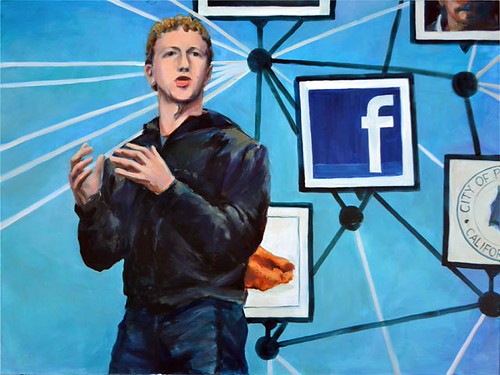
Just a picture I found. I think it portrays in a very literal manner us as produsers reaching out to others on the net… and what’s more the lack of privacy we have!
So In week 6 we examined WordPress itself. It is essentially a blogging site for the serious blogger who desires more control and input over their work, and allows for open contribution. However WordPress relies on the audience that is drawn from its most popular blogs, and this made me consider our generation today. It is true that as a digital native I find that I am more likely to gain information and news from online forums, online newspaper sites and even blogs. This demonstrates the shift from the traditional media to new media.
However I wanted to focus on this shift to the dominant online presence of blogs as a source of information, and a platform for anyone to express themselves. As noted by Technorati’s State of the Blogosphere 2010 Report, 65% of bloggers write blogs merely as a hobby. It’s incredible to think that there is such a global desire to write about one’s experiences, interests, travel etc.
When thinking of a blog as reaching out to individuals from around the world, I suddenly thought of Tavi Gevision. Tavi was just 13 when she started her fashion blog ‘style rookie,’ and in her story the power of the blog is demonstrated. She has become world-renowned for her personal blog of style and fashion, portraying the current trend of the young generation today. Whilst being one of the most visited fashion blogs in the world, fashion designers also frequently visit her site so that they can gain the fresh perspective of a young fashionista.
In essence Tavi provides teens with ideas for creating their own sense of style to reflect their identity and feelings. Her blog is a pool of endless inspiration and beautiful photographs. ‘style rookie’ thus reflects the generation who are most involved in the blogging realm, and the overwhelming presence of blogs on the net.
Following week 10 tutorial’s exercise, explain why you chose the Creative Commons license that you added to your blog and discuss the relevance (or not) of adding the license.
The above video portrays the revolutionary ideas of Creative Commons, and their fundamental nature in providing creators with the tools to copyright their work in whatever form they deem suitable. More so, It seeks to emphasise the importance of freedom of expression so as to encourage all individuals to come together, to create a new culture where we can connect to build upon and transform each others work for better. It strives to challenge strict copyright laws and forge online communities.
For my WordPress I chose the Creative Commons Attribution-ShareAlike, as this license gives others the ability to utilise my work for commercial or non-commerical purposes, however they must acknowledge my work and must carry the same license. I believe this license has a great flexibility to it, and really enables users to enhance their own work through mine.
To understand the reasons for choosing a Creative Commons license, it is first important to understand the rationale for the creation of this license. Garcelon explains that Creative Commons “represents an attempt to roll back the intellectual property approach to copyright in order to facilitate more open access to creative works.” (Garcelon, 2009: 291) Hence it calls for ideas and information to be easily accessible and in the public realm, rather than tied up by legal restrictions.
So before adding the license I gave serious thought to how I wanted my work to be viewed and shared. I realised that my work needs to be expanded upon and transformed, and this can only be done through the Attribution-ShareAlike license. It is greatly satisfying knowing that I can reach out to others with my information which represents my inner thoughts, and together we can connect by mixing our ideas to form bigger and better things. Whether it be for commercial or non-commercial uses I don’t think that is really the issue, as restricting this would have been going against the ideas at the very core of the Creative Commons license. It’s about being as unrestricted as possible. That is why my work can be altered and profited upon. The only thing I’m holding on to is the right to be acknowledged, which I think as the creator is understandable.
Lastly Lessig sheds light on the need for an open society, deeming that we must “resist a world where to use and build upon resources from our culture you need the permission of Hollywood.” (Lessig, 2005: 305) This seeks to reinforce the need for the Creative Commons and it’s creation, which is to move away from thinking of ideas in terms of property to thinking of them in terms of ideas that can be shared by communities.He also reasserts how essential it is to have a free flow of information that is not constrained.
Thus Creative Commons aims to address these concerns by breaking free from the hold of society, and handing over power and control to the individuals…the creators.
Garcelon, M. (2009). ‘An Information Commons? Creative Commons and Public Access to Cultural Creations,’ New Media & Society, 11 (8): 291.
Lessig, L. (2005). ‘Open Code and Open Societies’. In Joseph Feller, Brian Fitzgerald, Scott A. Hissam and Karim R. Lakhini (eds.), Perspectives on Free and Open Source Software, Cambrdige, MA: MIT Press, 305.
So in Week 8 we looked at web design in particular focusing on the advancements since the web design nightmares of the 90’s. Today with Web 2.0 web pages are left looking streamlined, structured and most importantly simple. Take google for example it is simple to navigate, the font is easy to read and you understand your purpose when on the site. Whereas pages of the 90’s sported distracting animations, exessive adverts, clashing colours and a general lack of organisation.
When trying to think of an example for this I thought long and hard back to my childhood and then it struck me…the thing me and my friends were obsessed with Cursor Mania. Cursor Mania is basically a site where you can download crazy cursors to personalise your computer, this can be anything from a sparkling arrow, to a slice of cake, or one of my favourites the flying fairy! I went back to look at the website and got a rather nasty flashback to the good old days. The background of the home page is an unnecessary dark black pattern, words flash and move and it reminded me of the old media, and essentially internet before the year 2000. It is strange when looking at these web pages to think how dated and unfamiliar they seem in comparison to the clear style of web 2.0 which has become part of our everyday lives.
In week 5 we discussed privacy, ethics and reputation in relation to the internet. With the internet being such a current dominant force in society these days, it appears that the internet has become a platform for individuals to express themselves. This may be through the creation of a Facebook account, or uploading videos of ones self onto YouTube. Either way due to its global and influential presence we all feel the need to share ideas or information on the net, however I think a lot of people have failed to see the downside of this desire to share what should sometimes be left as internal thoughts. Some of us on Facebook have the sense to not share all of our personal details such as our full birthday, or understand that it is important that not everybody or friends of friends can see our pictures. We may feel liberated that a social networking hub such as Facebook can store and show off our pictures to the world so that others can know what we’ve been up to, but often things are made far too public.
It is said now days that employers check out our Facebook pages to monitor our pictures, and note whether we have joined any controversial groups. This demonstrates that in this world fuelled by the free flow of information what is believed to be freedom and self-expresison, can often be restrictive and dangerous. A balance must be found between engaging in the online realm and revealing too much about our personal lives. Take celebrities for example, they cannot have their own true FB page with pictures from nights out, and statuses describing their whereabouts. The freedom which others can experience through the knowing of such things is actually detrimental to them, thus privacy or effectively controlling the information they wish to divulge is key to their survival.
I have found an example on YouTube which merely explores a young girls internal dialogue. Ultimately this seeks to reinforce the idea that even those who have no reason or need to share information with others are led to desire this, due to a belief that through filming and posting films online they will hold power, and importance through their online presence.
A) Burgess and Green argue that: ordinary people who become celebrities through their own creative efforts “remain within the system of celebrity native to, and controlled by, the mass media”
In today’s society characterised by digital natives and the rise of online video individuals are able to become celebrities, reaching fame status through their own talent and creative endeavours. Hence YouTube provides individuals with a means to post videos and distribute one’s material, via a public platform. Here individuals who create amateur videos are able to gain exposure and reach success, whilst other forms of media prove hard for this fame to be realised.
Burgess and Green examine this DIY celebrity culture present on YouTube and identify what distinguishes an ordinary person from a celebrity. They argue that the “distance between ordinary citizen and celebrity can only be bridged when the ordinary person gains access to the modes of representation of the mass media.” (Burgess & Green, 2009: 22) By Doing so they make a transition from ‘ordinary worlds’ to ‘media worlds.’ (Burgess & Green, 2009)
It is also evident that an ordinary citizen can become a star from possessing a specific set of skills. This is depicted in the video above by Noah Kalina, a photographer who highlights an individuals talent and the ability for this to plummet them into stardom, as it has received 19,608,889 views. This was an ongoing project spanning over 6 years, and within this video Noah takes a picture of himself everyday. This artistic project reinforces the ease at which you can “broadcast yourself into fame and fortune.” (Burgess & Green, 2009: 22) By constantly updating and working on this project, he demonstrates the idea that one has to continually contribute in order to hold onto celebrity status.
Burgess and Green note that individuals who sky-rocket to fame on sites such as YouTube, are ultimately ruled by the mass media. They delve in the idea that most individuals remain within the system and are viewed as celebrities only through this. Asserting that the mark of success for these individuals in order to break free from YouTube, is determined by the events that follow their rise to fame. In the example of Kalina The Simpsons actually created an adaptation of Noah’s work, portraying Homer photographed everyday for 6 years. This acknowledges Kalina’s artistic abilities but also conveys his achievements, as he has been recognised by one of the most famous animated sitcoms of the century.
More so, Noah’s project conveys his passion of photography and his exhibitionist style, as it literally documents his everyday and YouTube has helped him to realise this and share it with the masses. Whether he remains within the system and controlled by the mass media, that is debatable. However I think that his video enabled him to reach out to others gaining exposure, as the millions of views it received demonstrate people’s appreciation for his work. By breaking free from online fame and reaching television, he reveals how he has become famous in his own right, and broken free from media control. Essentially his video is less about trying to receive positive impressions from viewers, as it is more so an expression of who he is through the art of photography. This in itself conveys the notion that he has managed to reach stardom and hold onto it, but through his own means.
References:
Burgess, J. and Green, J. (2009) ‘YouTube and The Mainstream Media,’ YouTube: Online Participatory Culture, Cambridge: Polity Press, p 22-23.
B) Lovink (Reader, page 222) also argues that: “No matter how much talk there is of community and mobs, the fact remains that blogs are primarily used as a tool to manage the self”.
Blogs are defined by the Oxford Dictionary as “a personal website or web page on which an individual records opinions, links to other sites, etc. on a regular basis.” There are many different forms of blogs, some informative say on fashion or news, whilst others are merely ‘online diaries’ sharing one’s inner most thoughts and confessions with others. (Lovonik: 29) Lovonik interestingly enough focuses on whether blogs are created to enable users to contribute to and become part of an online community, or whether they are essentially individual based and a device to manage our lives.
It is apparent that now days we can create our own WordPress or Blogspot account with such ease, and blog away to our hearts content. This reinforces the idea that these websites clearly provide a forum for individuals to muse about their daily lives, more so than other commerical blogs which are created to endorse a celebrity or sell a product. Hence there are blogs that exist which are ultimately informative to the individual and with the intention of providing a service to online users, however a predominantly large number of blogs are primarily concerned with blogging for the sake of it. This is reinforced by Technorati’s State of the Blogosphere 2010 Report, which acknowledges that 65% of bloggers do so purely as a hobby.
Lovonik asserts that “the essence of the blog is not the interactivity of the medium: it is the sharing of the thoughts and opinions of the blogger.” (Lovonik: 28) Hence blogs provide individuals with an outlet a means to structure their life by writing about their daily events, in essence an emotional outpouring but on a rather public domain. Some blogs don’t even allow comments which means that it is purely a one way flow of information from the bloggers mind to the net and then to cyber space. This emphasises the significance of the blogs in providing individuals with a sense of control and power. Web 2.0 ultimately enables users to become journalists regardless of their quality of writing, or quality of ideas. This is essentially why a lot of people blog, as it is merely for the satisfaction of having one’s thoughts published, and the ease at which one can post their private ideas publicly.
Willy’s Blog is a prime example of the notion of blogging about one’s daily life, as a means to organise and express the “relentless uncertainty of the everday.” (Lovonik: 29) It is simply a Blogspot blog by a professor and is titled ‘My Personal Blog,’ ‘All about my activities, thoughts, inspiration, ideas, and everything that happened around me.’ This is exactly what his blog is concerned with, as it covers mundane topics such as the task of marking exams, moving rooms and playing basketball. These may have been made interesting if the blogger had a way with words, and used humour to entice the reader. However these posts read like a diary, listing and explaining in great depth the goings on in his life. It definitely supports Lovonik’s belief that they are a device to manage and process ‘the self,’ but also portrays the power and importance one feels when blogging about themselves.
References:
Lovonik, G. ‘Blogging, The Nihilist Impulse,’ Zero Comments: Blogging and Critical Internet Culture, London: Routledge, p 28-29.
In week 4 we discussed the idea of participatory cultures in the lecture and how the line between consumer and producer, and private and public are becoming increasingly hard to define. It is definitely interesting to consider ourselves as produsers, as with the capabilities of new media we are essentially able to enter this public realm of culture with our own personal insights. Take blogs for example, these allow us to express our thoughts and share them with others. There are sites just like wordpress, or Wikipedia which allow the consumer to effectively become the producer, driving these companies more towards the provision of services, and in essence encouraging individuals to collectively contribute, transforming personal insights to become public. This networked public culture allows greater visibility by all, we can easily look at others blogs, make comments and share ideas.
The idea of creating something to be shared via the internet, and having control over content can be shown with YouTube, in which individuals who create films or clips can engage with others and decide upon the nature of the video for themselves. I found an example of participatory cultures when watching TV, and Two and a Half Men came on. The son Jake is creating a clip with his friend where they do silly stunts that they want to share on the internet. Have a look, and click on the link hopefully you’ll see how it relates to this notion of how personal information can become public within seconds, what’s more it conveys the idea of produsage pretty well, and it’s funny!